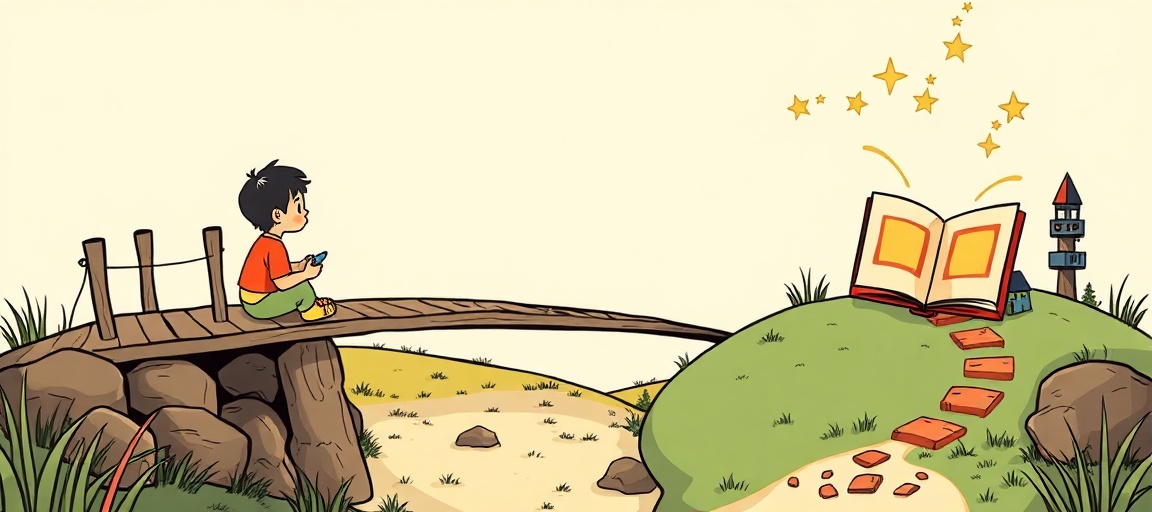
For once, not a feature blog. A vision. What we want Storytale to one day do, and why.
Language is more than writing
In education, language ability is often equated with spelling, grammar, and neat formulation. Understandable — those are measurable, and measurable is what a test asks for. But language itself is much broader. It's imagining. It's telling stories. It's associative thinking, seeing the connection between two things that don't seem to belong together, having the idea of a world where a shadow can talk.
A child can be brilliant at that kind of thinking while struggling with a pen. Or a keyboard. Or spelling. The idea exists — only the expression gets stuck on a specific skill. For such a child, an assignment to "write a story" effectively means: "show me you can write," and not: "show me what you can tell."
The problem of the mixed-ability class
In a typical class, a student writing at advanced level sits next to a student with dyslexia struggling to compose a simple sentence. Both have equally valuable ideas. Both have an equal right to participate.
A teacher can't differentiate that manually — not for 28 students at once, not without working three hours extra in the evening. Recent articles on AI in primary education confirm this: teachers who use AI to create levelled lesson materials win back time they can put directly into guidance.
AI as a bridge, not a replacement
This is where our vision comes in. Imagine: a class writes a story together in Storytale. One student writes "The elephant walked down the street." Another writes "The majestic pachyderm strode across the asphalt with a dignity normally reserved for royal visitors." In today's skewed reality, the second student would overshadow the first. But in an AI-supported Storytale game, the first sentence can carry just as much weight — not by polishing it, but by building on it as if both sentences carry equal content. Because they do.
A 2025 study on AI in primary school writing ability showed that students who used AI as support reported a significant increase in their confidence around writing. Not because the AI took over their work, but because the barrier to starting disappeared.
Differentiation without extra work
A dreamed-of Storytale for schools would know each student's level. An 8-year-old doesn't need to write complete sentences — a few words, a drawing, a spoken sentence via the microphone. The AI turns it into an appropriate prose sentence that the group can carry forward. The content belongs to the child. The form is assisted.
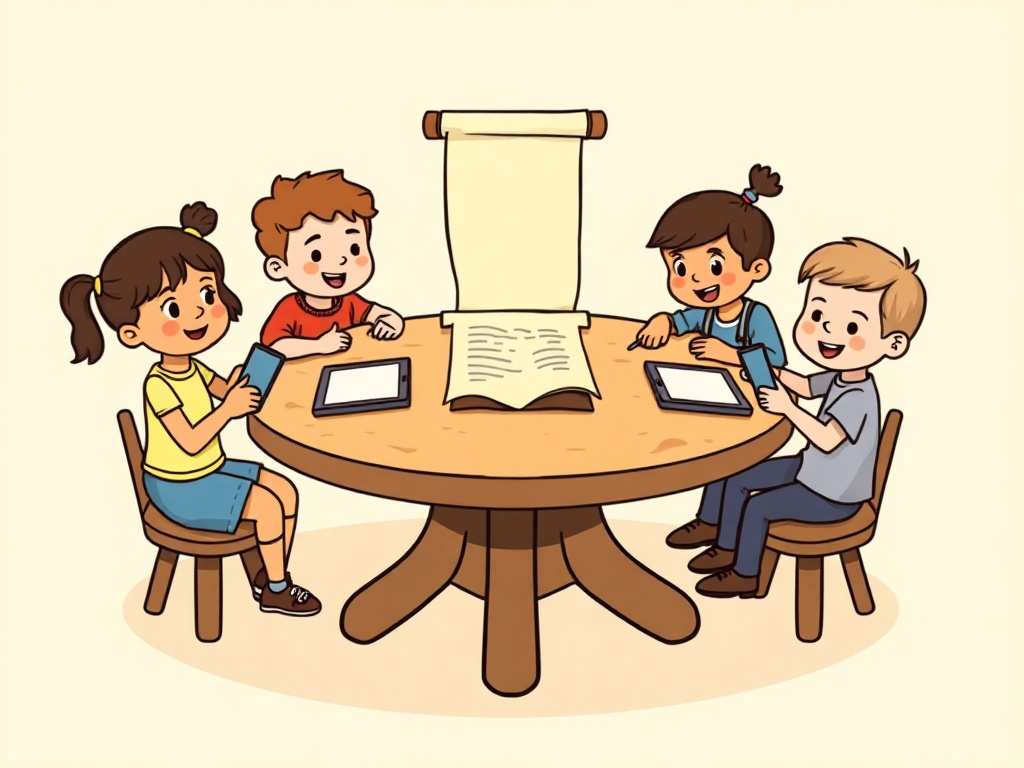
For a student with dyslexia this means: spelling errors disappear silently, the feeling that "your sentence is holding up the group" disappears. For a gifted student: there's enough room for long, image-rich sentences without losing the group. Everyone writes the same book together — each in their own way.
"Imagining is language. Writing is one aspect of language. We shouldn't elevate one aspect into the measure of the whole child."
What we don't want
AI tools in education are not automatically good. We don't want:
- The AI as ghostwriter. That takes away the child's own achievement.
- Assessment AI. Having an algorithm grade an essay is not what we're after here.
- Surveillance platform. No scoreboards, no student tracking systems, no data sold to third parties.
- Replacing the teacher. The teacher sees; the AI supports.
What we do want
We want a tool that gets children working together with language at the same table. That puts the imagining process at the centre and quietly supports the writing process. That makes it fun to participate, regardless of ability. And that gives teachers an hour back in the evening through automatic differentiation that would otherwise have been manual work.
Storytale isn't there yet. We have the game engine, the AI integration, the portraits, the story structure. What we're missing for education:
- A teacher dashboard with multiple live games visible at once
- Voice input so children can speak instead of type
- Level-sensitive AI editing (same idea, different expression per student)
- A PDF export so the story can actually go home
- A privacy mode that specifically meets GDPR and school requirements
An invitation
Are you a primary or secondary school teacher and would you like to think along with us? Send us an email. Not to promise anything (we haven't built this yet), but to understand what you actually need. A vision without the people who want to put it into practice is at best a nice slide deck.
Our ambition: that Storytale one day becomes a tool that belongs in a classroom. Not as "an AI experiment," but as a regular part of a language lesson where every child participates in their own way. Until then, we keep building. And keep listening.